

Last post we discussed what insulin resistance is and why it is so important for healthspan and longevity. We also discussed the importance of testing for insulin resistance with an oral glucose tolerance test (OGTT). I won’t rehash the details again but you may want to refer back to that post before digging into this one.
Now I want to get into what to actually do about it. Say you have high fasting glucose (a fasting glucose >90 indicates there is likely some insulin resistance going on), a high A1c >5.7, a HOMA-IR >2 (HOMA-IR is a validated test for insulin resistance and is calculated by taking the fasting glucose times the fasting insulin divided by 405), or the gold standard an OGTT showing insulin resistance - what do you do now? Below I am going to walk through everything you can do to stop it and reverse it. Let’s dig in.
Visceral fat and lean muscle mass
To best assess where to start with reversing your insulin resistance I would start with first getting a body composition analysis with Inbody or DEXA. We know that visceral fat is a major driver of insulin resistance and conversely lean muscle mass is a strong counter to insulin resistance. These 2 tests help us know how much of both of these someone has. I’ll show some of my previous tests below so you can see what these look like.

Above you can see the adipose indices from a previous DEXA scan of mine. You can see my total body fat was 22% (ideal probably closer to 15%). To see visceral fat look at the Est VAT Area. Mine is 82.1. The lower the better but we usually look for <100 here so I’m doing pretty good here. The second test you can do for visceral fat is the Inbody scan.

Above is one of mine. Here is it giving a similar calculation to the DEXA. My visceral fat area is 57.4, not bad. Again ideal is <100 but the lower the better. The second area we want to look at with these tests is lean muscle mass.

Here are my lean indices. The Lean/Height is a measure of the total lean muscle mass adjusted for the height and the Appen Lean/Height measures the lean muscle mass in the arms and legs (appendages) adjusted for the height. As you can see I’m in the lower percentiles for these. YN is young normal and I’m in the 13th percentile (so this means 87% of 20-29 year olds have more muscle mass than me). AM is aged matched so I’m around the 10th percentile here (90% of guys my age have more muscle than me). I need to hit the weight room. Lastly, below is the Inbody for lean muscle mass.

You want to look at the SMM (skeletal muscle mass) bar here. The key is having that bar extend out past the weight bar above and the body fat mass bar below. Mine is slightly farther so it forms a “D” configuration. So the Inbody has me doing better in the muscle department, but the DEXA is the most accurate (unfortunately for me).
So now that you know your visceral fat and lean muscle mass status you can make a plan for your diet and exercise. If you have a lot of visceral then one of you main priorities should be getting rid of that since it is one of the key drivers of insulin resistance (not to mention cardiovascular disease and dementia).
How to lose visceral fat
We’ll start with looking at some of the best ways to lose visceral fat, and first we’ll look at exercise.

We’ll take a look at this systematic review and meta-analysis by Vissers et al where they compiled date from 15 studies (852 subjects). This analysis is unique as these are studies that were looking at exercise only as a cause for visceral fat loss: there was no caloric restriction. Here’s what they found.

For those unfamiliar with reading confidence intervals here’s how to read this graph. Take a look at the bars across from the overall low intensity, overall moderate intensity and overall high intensity. For a result to be significant the bar should not touch the vertical line at 0.0. You can see that the overall low intensity cross the vertical line at 0.0 - this means that low intensity exercise was not significant for reducing visceral fat. But if you take a look at the overall moderate and overall high both of these do not touch the 0.0 line and are to the left of it (in the negative) meaning they are significant for REDUCING visceral fat. So what constituted moderate exercise? Moderate intensity exercise in these studies was defined as 60-70% of the HR max (HR max is determined as 220 - your age). The high intensity exercise was defined as HR max >70%. So first thing to do to lose visceral fat and in turn improve your insulin resistance is to get moving and get your HR up. Take 220 - your age (I’m 35 so my predicted max heart rate is 220-35 = 185 so 185 is my HR max) and then take 60% of that (for me that’s 185 x 0.6 = 111) and that is your starting number for where to get your heart rate up to for moderate exercise. A brisk walk will likely do this for most people. If not able to get it high enough you can throw on a weighted vest and that’ll do the trick. Once you build your aerobic base you can work up to high intensity HR zones and HIIT workouts for even better results.
Next way to lose visceral fat (and improve insulin resistance and other metabolic parameters) is through diet. I believe some of the best ways to do this is through the combination of time restricted eating (eat in an 8 hr window and fast for 16 hr window each day) and low carb diet with monthly cycling of a fasting mimicking diet (FMD). I’ll explain all this below.
Best diets for improving insulin resistance and reducing visceral fat
If trying to reduce visceral fat and improve insulin resistance (as well as dyslipidemia) one of the best diets to follow is going to be the combination of time restricted eating (TRE) and a low carb diet (LCD). This is illustrated nicely in the study below

This randomized controlled study looked at LCD, TRE and the combination of the 2. The clear winner was the combination for both improving visceral fat and insulin resistance. They kept daily carb intake around 150 grams a day and ate during an 8 hour window (with a 16 hr fasting window). This is all independent of physical activity which we now can augment this even further.
Now if we want to add further to what we are doing with the combo diet above you can do a 5 day fast mimicking diet (FMD) on a regular basis. These have been shown to reduce visceral fat and insulin resistance among other things.

This was an RCT that showed that 3 monthly cycles of the 5 day FMD reduced insulin resistance, lowered hepatic fat (visceral fat) and improved immune function parameters. There was also the added effect of lowered biological age. No affiliation be I like using the Prolon 5 day fast mimicking kits. They make it very simple to use.

Putting it all together TRE on a LCD with periodic 5 day FMD is likely to be a very robust diet regimen to reverse insulin resistance and reduce visceral fat.
We’ve looked at exercise for reducing visceral fat and improving insulin resistance as well as the best diets for reducing visceral fat and improving insulin resistance. These are probably the 2 most effective means. Next we’ll look at medications, supplements and peptides.
Meds, supplements, peptides and insulin resistance - building the ultimate stack
First we’ll take a look at medications known to reduce insulin resistance and we’ll start with Metformin.
Metformin has been around for a long time - first synthesized in 1922. It’s primary effects and mechanisms of action are inhibition of hepatic gluconeogenesis (less liver production of glucose) and AMPK activation which can enhance insulin sensitivity. In our practice we like to let genetics be our guide for a lot of things so we pay particular attention to a SNP (single nucleotide polymorphism, fancy term for a particular gene that can have a change at a single base pair which can in turn alter its function either for good or bad) called ENPP1. The C allele here is associated with particular risk for type 2 diabetes, especially if homozygous (2 “C” alleles). When you have the C allele here it increases the expression of the ENPP1 protein which essentially reduces your insulin sensitivity by inhibiting the insulin receptors.1 Metformin is unique here as it has been shown to reduce expression of ENPP1 and thereby will increase insulin sensitivity.2 Metformin can be a great tool for insulin resistance in this situation.
Next lets look at pioglitazone. This drug gets forgotten a lot and I think it is unfortunate. It got a lot of bad press due to some issues with a similar drug called rosiglitazone. A 2007 meta analysis showed that rosiglitazone was associated with increased risk for heart attack and cardiovascular death.3 Unfortunately use of pioglitazone was significantly reduced after this although the similar risk was never shown and in fact multiple studies have shown lower risk for heart attack, stroke and death. A couple things to keep in mind with pioglitazone: 1) it can increase fluid retention (and in turn can cause some weight gain from this) - so if there is any history of heart failure proceed with caution. 2) there are some signals for higher risk for bone fractures in some studies - so if there is history of fragility fractures or osteopenia/osteoporosis you might also want to proceed with caution. 3) there are some signals in studies that there might be a small increased risk for bladder cancer, both duration and dose dependent - so if using pioglitazone I would suggest lowest dose and use as part of a multitargeted plan for a few months, not long term.
So how does pioglitazone work and why is it important here even with some of the possible risks shown above? Pioglitazone primarily works by activating something called PPAR-y. PPAR-y then activates several genes involved in glucose metabolisms, insulin signaling and fat metabolism and distribution. Here are the key things that happen. 1) fat redistribution - it encourages free fatty acid storage into subcutaneous fat rather than visceral fat. 2) it increases adiponectin and lowers inflammatory markers - both of which will improve insulin sensitivity. 3) enhanced glucose uptake in muscles. 4) reduced liver glucose production. The upside you get with this drug I think far outweighs the small risks here - especially if you use a low dose for short period in a low risk group.
Finally we will look at SGLT2 inhibitors and GLP1 agonists. These are the newer kids on the block. Both very effective for many reasons not just insulin resistance and hyperglycemia.
SGLT2i are a class of medications that inhibit the SGLT2 transporter in the kidneys. These transporters bring glucose back in the body so by inhibiting them you increase the excretion of glucose in the urine. They are very effective at lowering overall glucose levels, blunting glucose spikes, improving insulin resistance and even some reductions in visceral fat. Main side effects to watch for here are mild blood pressure reductions and urinary tract infections or genitourinary yeast infections (these infections can sometimes prevent use of this medication due to severity or repetitive nature).
Finally GLP1 agonists (probably the most popular) are very effective but also can come with significant side effects. These drugs primarily work by increasing insulin secretion from the beta cells of the pancreas, slowing gastric emptying down and increasing satiety. This lowers blood sugars, improves insulin resistance and results in weight loss due to the increased fullness and lowered appetite. The primary side effects (which can be severe) are GI related (nausea, vomiting, constipation, bowel blockage) and muscle wasting (from rapid weight loss). In our practice if we use GLP1 agonists we always prefer to use the lowest effective dose and never push into the high ranges due to these side effects. Yes you can loose a lot of weight on these drugs if you titrate up to the max but that comes at the cost of muscle wasting - and we see this on our clients that choose to do this, massive muscle loss. In your older years it is very hard to put this muscle back on. There is a much healthier and better way to approach use of these drugs - I’ll try to do a post on this in the future but for now we’ll just say that low and slow is preferred and you have to be doing things to preserve muscles while on it (optimize hormones, consider concurrent growth hormone analogs like sermorelin or tesamorelin, and engage in resistance exercises). Last thing on GLP1 agonists - genetics play a role here as well. There are a couple SNPs (GCK and TCF7L2) that can results in significantly lower insulin secretion due to improper signaling and adding a GLP1 agonist in here to increase the insulin signal can be very helpful.
My take on medications. Start with personal history/risk factors and genetics and build plan from there. If there is history of kidney disease or cardiovascular disease then we would want to start with SGLT2i and GLP1 agonist because we know these have added benefits in those populations. If we know that that the above SNPs are at play we can choose targeted therapies based on that (metformin for ENPP1 or GLP1 agonists for GCK and TCF7L2). Think about adding on pioglitazone in a low risk patient for a short period for added benefit. Of course all of this would be combined with the diet and exercise recommendations above.
Supplements
The next section is supplements. There’s a lot here that can help. I’ll list them out and recommend where each might fit. Listed in no certain order.
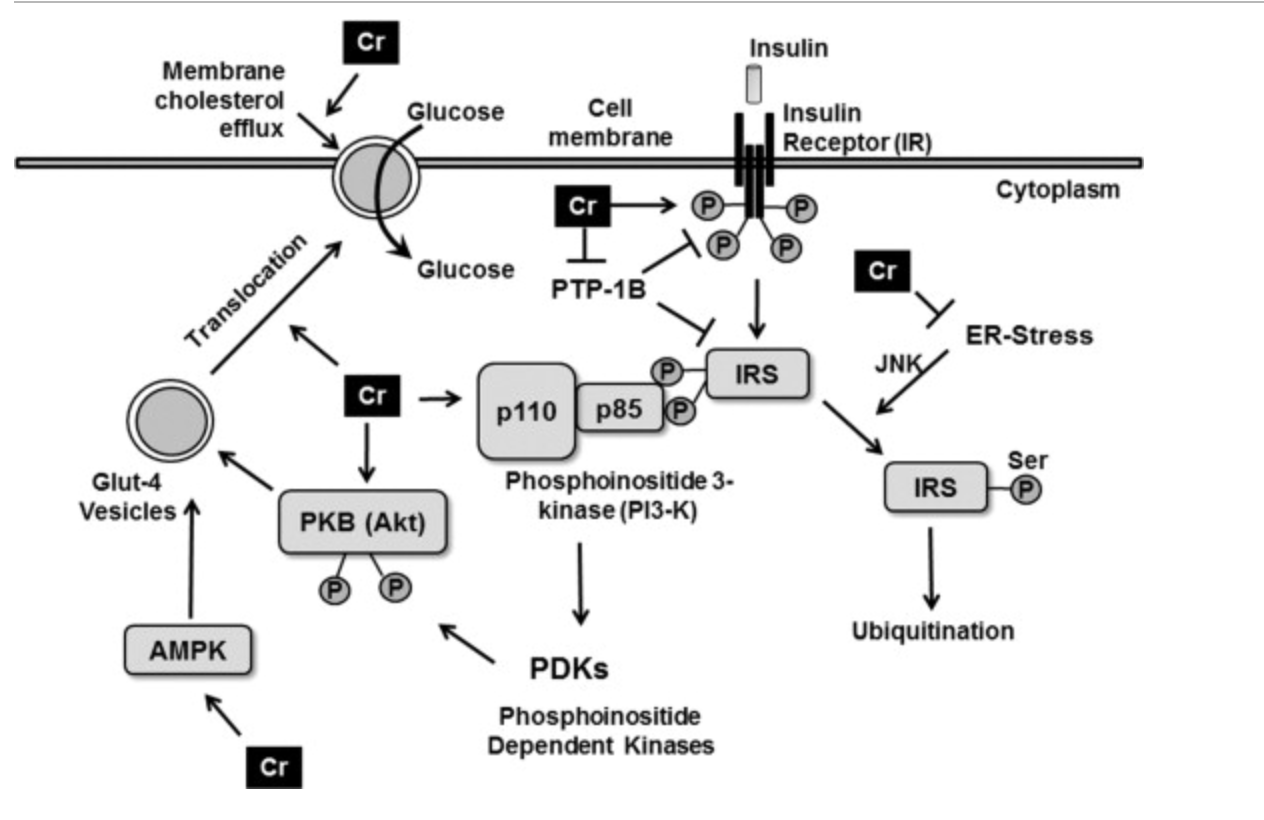
Chromium: Very important mineral. We measure this on all of our clients. If low and insulin resistant then very important to replete. As you can see from the graphic below chromium is very involved the whole glucose insulin regulation but most importantly is helps with insulin receptor activation and signaling and glucose channel opening.4
Gymnema sylvestre: this is a medicinal plant and has also been shown to improve insulin sensitivity.5
Berberine: similar to metformin, berberine activates AMPK which in turn increases insulin sensitivity and improves mitochondrial function.6
Ginseng: increases insulin production and reduced pancreatic B cell death.7
Cinnamon: enhances glucose uptake and insulin signaling.8
Alpha lipoic acid: enhances glucose uptake and insulin sensitivity. 9
Bitter melon: insulin sensitizer

There are others - this is not a complete list but these are some of the main ones and ones I typically use. One of my favorite products because it combines most of the above into one is the Xymogen CinnDromeX:

This makes it easy to hit the key supplements all in one. For me I would consider starting with something like this in addition to diet and exercise. From there add in targeted medications based on history, genetics and severity of condition.
Peptides
Last lets talk about the hop topic of peptides. We’ve actually already talked about one class and that is the GLP1 agonists. Others that can potentially help with insulin resistance include MOTS-c, SS-31, melanotan II, tesamorelin, sermorelin, and other growth hormone analogs.
MOTS-c. A mitochondrial-encoded peptide that translocates to the nucleus under metabolic stress and up-regulates AMPK-linked, exercise-like programs in skeletal muscle; increases glucose uptake and shifts substrate use toward fatty-acid oxidation. Robust rodent data: prevents and reverses diet- and age-related insulin resistance and obesity; improves insulin tolerance tests. Human data are still early/limited.10
SS-31 (elamipretide). Mitochondria-targeted tetrapeptide that binds/stabilizes cardiolipin, improves electron transport efficiency, reduces ROS, and can enhance mitophagy—addressing mitochondrial contributors to insulin resistance. In mice, SS-31 attenuates burn-induced insulin resistance and restores insulin signaling/glucose tolerance; in db/db mice, elamipretide protects diabetic organs (kidney), consistent with improved mitochondrial redox—but direct human insulin-sensitivity gains aren’t shown.1112
Melanotan II (MT-II). A potent melanocortin (MC3/MC4) agonist that suppresses appetite and weight and can centrally modulate glucose/insulin signaling. In obese, insulin-resistant OLETF rats, peripheral MT-II improved insulin tolerance more than pair-feeding, implying a weight-loss–independent effect; central administration also enhanced insulin sensitivity in rodents. Human data are lacking.1314
Tesamorelin (GHRH analog). Stimulates physiologic GH pulsatility → increases IGF-1, lipolysis, and preferential visceral adipose tissue (VAT) reduction; VAT loss can secondarily improve hepatic/muscle insulin sensitivity, but GH axis activation can transiently worsen glycemia. In HIV-associated lipodystrophy: ~15–20% VAT reduction over 6–12 months; liver fat decreases; early studies show initial clamp-measured insulin sensitivity/glycemia perturbation that attenuates over time; some trials report no meaningful long-term glucose worsening, others note a modest A1c rise. Net effect on insulin resistance is mixed but often neutral/slightly adverse short-term, with body-composition benefits longer-term.1516
Sermorelin (GHRH analog). Increase endogenous GH/IGF-1 pulses (more physiologic than exogenous GH). GH acutely antagonizes insulin’s anti-lipolytic actions and can induce hepatic insulin resistance; long-term body-comp changes may partially offset this in some contexts. Small older human study of a GHRH analog reported improved insulin sensitivity in men but not women; results aren’t consistent across studies. With GH replacement in GH-deficient adults, meta-analyses show worsened or unchanged glucose metabolism at 6–12 months, with more neutral findings over longer durations. Sermorelin itself lacks high-quality modern metabolic trials.17
More study needs to be done here but as you can see these can be very powerful in the right setting under the right supervision.
Putting it all together
To get the best effect you have to address all areas and combine all of these treatments. In our practice we focus on using all of these tools. It all starts with diet and exercise - this is key and if not present you will not have success. Second add in targeted medications, supplements and peptides based on body comp, degree of insulin resistance, genetics, risk factors, and how aggressive the patient may or may not want to be. If there is significant mitochondrial dysfunction (noted from other testing such as ME screen) then we might add SS-31 or MOTS-c. If they are obese and have significant visceral fat then the addition of a GLP1 agonist with a growth hormone analog would be a great choice to lose the visceral fat without losing muscle mass. If there is significant cardiovascular risk or disease then we’d want to start with SGLT2i and GLP1 agonist. It’s an art to put all these pieces together in the right way for each patient - this is why you need to find an experienced precision medicine longevity doc who can do this.
Frequently asked questions
How do you reverse insulin resistance?
Reversing insulin resistance starts with diet and exercise; without them, other treatments will not succeed. From there, targeted medications, supplements and peptides are added based on body composition, degree of insulin resistance, genetics, risk factors and how aggressive the patient wants to be. A body composition scan (InBody or DEXA) to measure visceral fat and muscle is a good first step.
What is the best diet for insulin resistance?
Combining time-restricted eating (an 8-hour eating window with a 16-hour fast) with a low-carb diet of around 150 grams of carbs a day beat either approach alone for visceral fat and insulin resistance in a randomized study. Adding a periodic 5-day fasting mimicking diet, shown to reduce insulin resistance over three monthly cycles, strengthens the regimen further.
What kind of exercise reduces visceral fat?
Moderate- and high-intensity exercise reduced visceral fat without calorie restriction in a Vissers et al. meta-analysis of 15 studies; low intensity did not. Moderate intensity means 60–70% of your max heart rate, estimated as 220 minus your age. A brisk walk gets most people there, and a weighted vest can help if not.
What medications treat insulin resistance?
The main options are metformin, pioglitazone, SGLT2 inhibitors and GLP-1 agonists. The choice depends on personal history, risk factors and genetics: SGLT2 inhibitors and GLP-1 agonists are preferred with kidney or cardiovascular disease, metformin suits the ENPP1 variant, and pioglitazone may be added briefly in low-risk patients. All are combined with diet and exercise.
References
The ENPP1 K121Q polymorphism is associated with type 2 diabetes and related metabolic phenotypes in a Taiwanese population Hsiao T-J, Lin E. Molecular and Cellular Endocrinology. 2016 10.1016/j.mce.2016.05.020
ENPP1 mRNA levels in white blood cells and prediction of metformin efficacy in type 2 diabetic patients: a preliminary evidence Ludovico O, Farina MG, Copetti M, et al. Nutr Metab Cardiovasc Dis. 2012 10.1016/j.numecd.2011.05.008
Nissen SE, Wolski K. Effect of rosiglitazone on the risk of myocardial infarction and death from cardiovascular causes. New England Journal of Medicine. 2007;356(24):2457-2471. doi:10.1056/NEJMoa072761
Molecular mechanisms of chromium in alleviating insulin resistance Hua Y, Clark S, Ren J, Sreejayan N. J Nutr Biochem. 2012 10.1016/j.jnutbio.2011.11.001
Phytochemical and Pharmacological Properties of Gymnema sylvestre: An Important Medicinal Plant. Tiwari P, et al. Biomed Res Int. 2014;2014:830285. doi: 10.1155/2014/830285
Effects and mechanisms of berberine in diabetes treatment. Yin J, et al. Acta Pharmaceutica Sinica B Volume 2, Issue 4, August 2012, Pages 327-334 doi: 10.1016/j.apsb.2012.06.003
Ginseng on Hyperglycemia: Effects and Mechanisms Luo JZ, Luo L. Evid Based Complement Alternat Med. 2009 10.1093/ecam/nem178
Zarezadeh, M., Musazadeh, V., Foroumandi, E., Keramati, M., & Ostadrahimi, A., et al. (2023). The effect of cinnamon supplementation on glycemic control in patients with type 2 diabetes or with polycystic ovary syndrome: an umbrella meta-analysis on interventional meta-analyses. Diabetology & Metabolic Syndrome, 15(1), 127. doi:10.1186/s13098-023-01057-2
Alpha-Lipoic Acid and Glucose Metabolism: A Comprehensive Update on Biochemical and Therapeutic Features. Capece U, et al. Nutrients. 2022 Dec 21;15(1):18. doi: 10.3390/nu15010018
Lee C, Zeng J, Drew BG, Sallam T, Martin-Montalvo A, Wan J, Kim SJ, Mehta H, Hevener AL, de Cabo R, Cohen P. The mitochondrial-derived peptide MOTS-c promotes metabolic homeostasis and reduces obesity and insulin resistance. Cell Metab. 2015 Mar 3;21(3):443-54. doi: 10.1016/j.cmet.2015.02.009. PMID: 25738459; PMCID: PMC4350682.
J.D. Chavez, X. Tang, M.D. Campbell, G. Reyes, P.A. Kramer, R. Stuppard, A. Keller, H. Zhang, P.S. Rabinovitch, D.J. Marcinek, & J.E. Bruce, Mitochondrial protein interaction landscape of SS-31, Proc. Natl. Acad. Sci. U.S.A. 117 (26) 15363-15373, https://doi.org/10.1073/pnas.2002250117 (2020).
Carter EA, Bonab AA, Goverman J, Paul K, Yerxa J, Tompkins RG, Fischman AJ. Evaluation of the antioxidant peptide SS31 for treatment of burn-induced insulin resistance. Int J Mol Med. 2011 Oct;28(4):589-94. doi: 10.3892/ijmm.2011.752. Epub 2011 Jul 19. PMID: 21805045; PMCID: PMC4090514.
Heijboer AC, van den Hoek AM, Pijl H, Voshol PJ, Havekes LM, Romijn JA, Corssmit EP. Intracerebroventricular administration of melanotan II increases insulin sensitivity of glucose disposal in mice. Diabetologia. 2005 Aug;48(8):1621-6. doi: 10.1007/s00125-005-1838-8. Epub 2005 Jun 22. PMID: 15971058.
Banno R, Arima H, Sato I, Hayashi M, Goto M, Sugimura Y, Murase T, Oiso Y. The melanocortin agonist melanotan II increases insulin sensitivity in OLETF rats. Peptides. 2004 Aug;25(8):1279-86. doi: 10.1016/j.peptides.2004.05.007. PMID: 15350695.
Sharma R, Kopchick JJ, Puri V, Sharma VM. Effect of growth hormone on insulin signaling. Mol Cell Endocrinol. 2020 Dec 1;518:111038. doi: 10.1016/j.mce.2020.111038. Epub 2020 Sep 20. PMID: 32966863; PMCID: PMC7606590.
Falutz J, Potvin D, Mamputu JC, Assaad H, Zoltowska M, Michaud SE, Berger D, Somero M, Moyle G, Brown S, Martorell C, Turner R, Grinspoon S. Effects of tesamorelin, a growth hormone-releasing factor, in HIV-infected patients with abdominal fat accumulation: a randomized placebo-controlled trial with a safety extension. J Acquir Immune Defic Syndr. 2010 Mar;53(3):311-22. doi: 10.1097/QAI.0b013e3181cbdaff. PMID: 20101189.
O. Khorram, G. A. Laughlin, S. S. C. Yen, Endocrine and Metabolic Effects of Long-Term Administration of[ Nle27]Growth Hormone-Releasing Hormone-(1–29)-NH2 in Age-Advanced Men and Women, The Journal of Clinical Endocrinology & Metabolism, Volume 82, Issue 5, 1 May 1997, Pages 1472–1479, doi:10.1210/jcem.82.5.3943